Permutation Flow-Shop
This is a variant of the Flow-shop scheduling problem (FSSP) in which the sequence of jobs is the same in every machine.
In this example it is not written from scratch, but simply makes use of a very efficient implementation available together with bnbpy in the auxiliary module bnbprob.
You can compare this implementation to MILP solvers at the end of the notebook.
[1]:
from bnbprob.pafssp import LazyBnB, PermFlowShop, plot_gantt
from bnbpy import plot_tree
Simple Problem
[2]:
p = [
    [5, 9, 7, 4],
    [9, 3, 3, 8],
    [8, 10, 5, 6],
    [1, 8, 6, 2]
]
[3]:
problem = PermFlowShop.from_p(p)
bnb = LazyBnB(problem, save_tree=True)
[4]:
sol = bnb.solve(maxiter=50000)
print(sol)
Status: OPTIMAL | Cost: 43.0 | LB: 43.0
[5]:
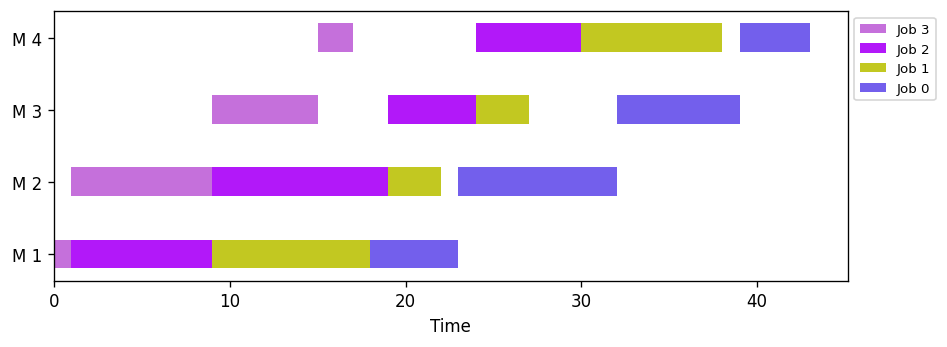
plot_gantt(sol.problem.sequence, dpi=120, seed=42, figsize=[8, 3])
[6]:
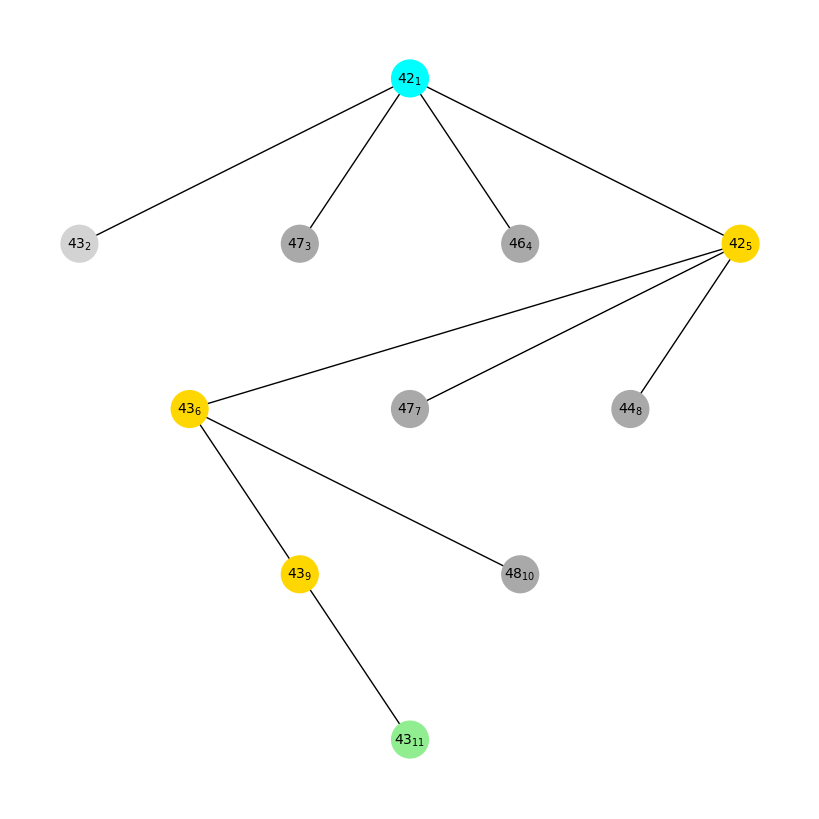
plot_tree(bnb.root, figsize=[8, 8], font_size=10)
In this implmentation lower bounds are computed by the max of a single machine and a two machine relaxations.
The bounds for single and two-machine problems are described by Potts (1980), also implemented by Ladhari & Haouari (2005), therein described as ‘LB1’ and ‘LB5’.
The constructive attribute selects the warmstart strategy: ‘neh’ uses Nawaz et al. (1983), ‘quick’ uses the slope-sorting heuristic by Palmer (1965), ‘multistart’ applies randomized multi-iteration NEH, and ‘iga’ uses the Iterated Greedy Algorithm by Ruiz & Stützle (2007).
References
Ladhari, T., & Haouari, M. (2005). A computational study of the permutation flow shop problem based on a tight lower bound. Computers & Operations Research, 32(7), 1831-1847.
Nawaz, M., Enscore Jr, E. E., & Ham, I. (1983). A heuristic algorithm for the m-machine, n-job flow-shop sequencing problem. Omega, 11(1), 91-95.
Potts, C. N. (1980). An adaptive branching rule for the permutation flow-shop problem. European Journal of Operational Research, 5(1), 19-25.
Palmer, D. S. (1965). Sequencing jobs through a multi-stage process in the minimum total time—a quick method of obtaining a near optimum. Journal of the Operational Research Society, 16(1), 101-107.
Ruiz, R., & Stützle, T. (2007). A simple and effective iterated greedy algorithm for the permutation flowshop scheduling problem. European Journal of Operational Research, 177(3), 2033-2049.
Bonus - MILP Model
This is the usual Position-based MILP model as an alternative to compare performance.
import pyomo.environ as pyo

from bnbprob.pafssp.mip import positional_model

model = positional_model(p)


# HiGHS
solver = pyo.SolverFactory("appsi_highs")
solver.options["mip_heuristic_effort"] = 0.1
solver.options["time_limit"] = 120
solver.options["log_file"] = "Highs.log"
solver.solve(model, tee=True)

# Gurobi
solver = pyo.SolverFactory("gurobi", solver_io="python")
solver.options["Heuristics"] = 0.2
solver.options["Cuts"] = 2
solver.options["TimeLimit"] = 120
solver.solve(model, tee=True)